
Marian Anderson (1897-1993)
by Randye Jones
Introduction
 Many African American operatic and concert singers, including Leontyne Price, Jessye Norman, Shirley Verrett, and Kathleen Battle, have credited Marian Anderson with inspiring them to pursue professional vocal careers. Norman recalled the first recording she heard of the contralto: “I listened, thinking, ‘This can’t be just a voice, so rich and beautiful.’ It was a revelation. And I wept.”1
Other “Black Divas” have come before Anderson: Elizabeth Taylor-Greenfield, Marie Selika, and Sissieretta Jones; none, however, broke through the glass ceiling of race or gained more than modest notoriety. What about Marian Anderson allowed her to go beyond the level of professional success her predecessors and even her contemporaries achieved?
Anderson’s Early Years
Contralto Marian Anderson was born in Philadelphia, Pennsylvania. Several sources suggest February 17, 1902, as her birthdate; however, Anderson’s birth certificate, released by her family after her death, lists the date as February 27, 1897. Her father was an ice and coal salesman, and her mother was a former teacher.
 Although Anderson had shown an early interest in the violin, she eventually focused on singing. The Black community recognized her talent and gave her financial and moral support. She also caught the attention of tenor Roland Hayes, who guided her developing career.
Anderson faced overt racism for the first time when she tried to apply for admission to a local music school. She recalled her reaction to the admissions clerk’s racial comments:
“I don’t think I said a word. I just looked at this girl and was shocked that such words could come from one so young. If she had been old and sour-faced I might not have been startled. I cannot say why her youth shocked me as much as her words. On second thought, I could not conceive of a person surrounded as she was with the joy that is music without having some sense of its beauty and understanding rub off on her. I did not argue with her or ask to see her superior. It was as if a cold, horrifying hand had been laid on me. I turned and walked out.” 2
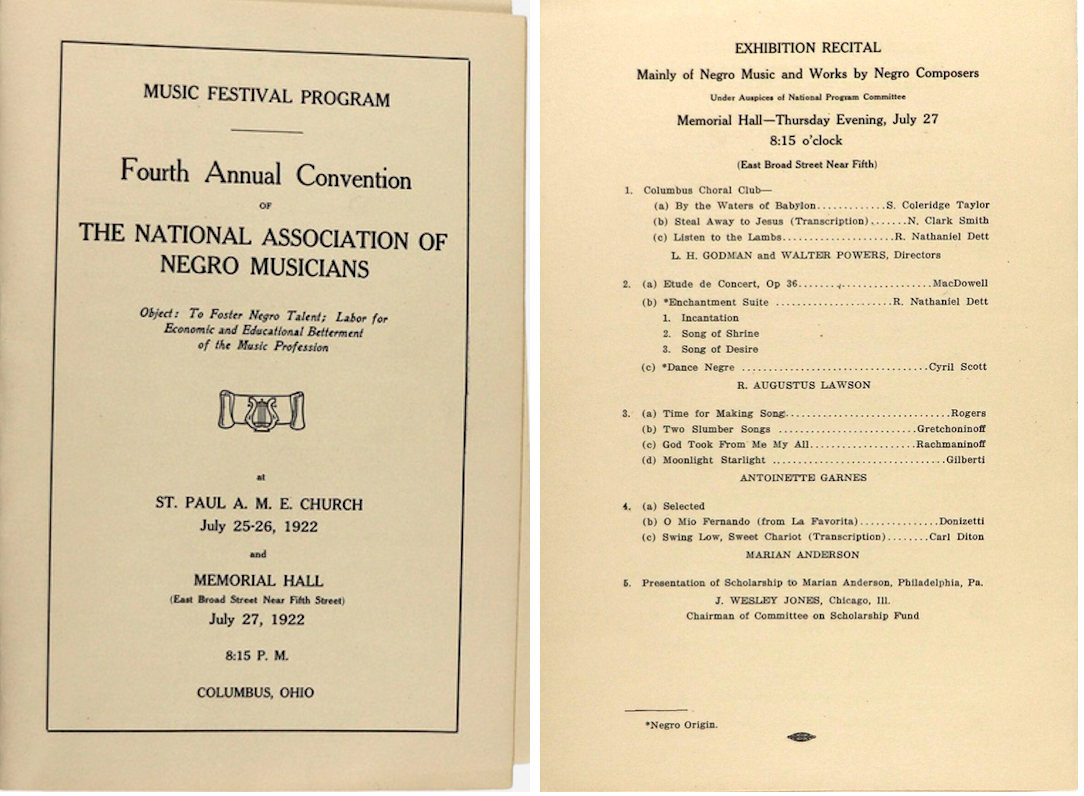
She did, however, find a teacher who gave her free lessons. Later, with donations from a local church, Anderson studied with tenor/coach Giuseppe Boghetti. She toured regionally, gaining knowledge and confidence with each performance. The National Association of Negro Musicians presented their scholarship to Anderson at their 1922 annual convention, where she also performed Carl Diton’s setting of “Swing Low, Sweet Chariot.”
 Between December 1923 and December 1924, Anderson made her first professional recordings with Victor Talking Machine. The three 78-RPM discs included five spiritual settings composed by Harry T. Burleigh, including “Deep River” (pictured right, with link to audio recording), and one by Lawrence Brown.
In 1924, she gave her first recital at New York’s Town Hall. The concert revealed Anderson’s discomfort with foreign languages and almost caused her to end her vocal career.
Boghetti convinced her to continue her studies. Despite winning a New York Philharmonic-sponsored competition the following year, Anderson could not establish an active career in the United States. She went to London in 1925 to study and to seek out professional opportunities where her race was less likely to be a factor. She visited Germany and Finland, where she met composer Jean Sibelius, who dedicated the song “Solitude” to her. During the next ten years, she performed extensively in Europe, including an appearance during the 1935 Mozart festival in Austria. She sang before the Archbishop of Salzburg and many of Europe’s leading musicians. Her performance led the archbishop to request an encore of Schubert’s “Ave Maria” and Arturo Toscanini to state “Yours is a voice one hears once in a hundred years.”

The Milestones
Anderson returned to the United States in 1935 for a recital at Town Hall, which this time was a critical success.
Under the management of Sol Hurok, she became the country’s third highest concert box office draw. Her successes, however, did not exempt her from racial discrimination. Restaurants, hotels, and concert halls often refused her accommodations.
The most publicized racial incident involving Anderson occurred in 1939, when Hurok and officials from Howard University tried to arrange a concert for her in Constitution Hall, the largest and most appropriate indoor venue in Washington, D.C. The hall’s owners, the Daughters of the American Revolution, sparked national protests when they refused to allow her to sing there.

(Burlington, North Carolina), 12 Apr 1939, page 2 (click on image to enlarge)
In answer to the protests, the United States Department of the Interior, with active encouragement from First Lady Eleanor Roosevelt, scheduled a concert on the steps of the Lincoln Memorial on April 9, 1939. The Easter Sunday program drew a crowd of 75,000 people and millions of radio listeners, and the entire episode caused the news media to focus greater attention on subsequent cases of discrimination involving Anderson and other African Americans.
(In the May 18, 1993, edition of the New York Times, writer William H. Honan reported that sources familiar with the incident attributed Constitution Hall’s “white artists only” policy to then-manager Fred E. Hand. Hand instituted the policy after a racially motivated incident occurred during a Roland Hayes recital at the hall in 1931. The policy remained in place, with the tacit approval of DAR’s executive committee, until Hand’s retirement.)
Four years after the 1939 Lincoln Memorial concert, the DAR invited Anderson to perform to raise funds for the Allied effort during World War II. The DAR agreed to rescind its all-white policy and allow an integrated audience for the occasion:
The momentous recital took place on January 7, 1943; the proceeds of $5400–over $88,000 in today’s [2014] dollars–were earmarked for United China Relief, another wartime aid charity. The Times reported that the concert drew “a distinguished and a capacity audience,” filling the hall’s 3,844 seats. Mrs. Roosevelt entered her box to a hearty burst of applause…. “Present also throughout an audience as unique as it was distinguished,” the Times noted, “were scores of Negro music lovers, ranging from Dr. Mordecai Johnson from Howard University to humble house servants who turned out to hear and applaud Miss Anderson.” She performed selections from Schubert, Haydn, Massenet, Griffes, Sadero and Quilter, and four Negro spirituals, including “Crucifixion” and “My Soul’s Been Anchored in the Lord.”3
 Anderson would return to Constitution Hall for performances in 1953, 1956, 1960, and would begin her farewell American tour there in 1964.
In 1954, Metropolitan Opera general manager Rudolf Bing signed Anderson for the role of Ulrica in the Met’s production of Un Ballo in Maschera, by Giuseppe Verdi. Author Jared Rutter’s account of the singer’s preparation for the historic event seems to bring Anderson’s rejection by that admissions clerk so many years ago full circle:
She worked on the part with an opera coach and one of the assistant conductors, and everything began to fall into place. Never having performed in opera she felt the need for special instruction in her acting and stage gestures, and she got it from the patient, insightful director, Herbert Graf. She recalled the preparation period in the fall of 1954 as one of the most intensely creative times of her life. “The concentrated work caused the blood to race through me with new meaning. I felt incredibly alive.” On the first day of rehearsal her spirits soared even higher when she entered backstage and a stagehand greeted her with, “Welcome home.”4
Her debut on January 7, 1955, marked the first time that an African American had sung on the Met stage. Although critics described her performance as beginning tentatively and her voice as showing the effects of her age–she was 57, author Rosalyn Story explained:

Obviously, Bing could have given the honor of “first black” to someone younger and musically stronger, like soprano Mattiwilda Dobbs, who had succeeded at La Scala and the Glyndebourne Festival in England, or baritone Robert McFerrin, who was engaged at the Met immediately after Anderson. But the point was clear; Anderson, whose career had quietly and continuously broken barriers, dissolved hostilities, and awakened the consciousness of an entire country, was the only singer whose presence could signify the real meaning of the event. The length and contour of her own journey, from poor prodigy to artist-ambassador in the span of half a century, mirrored the progress of an entire movement of people advancing toward artistic and social equality. Anderson’s life, in simple terms, defined that movement.5
 Using the $10,000 she received as part of Philadelphia’s 1941 Bok Award, the contralto established the Marian Anderson Scholarships, which supported several up-and-coming musicians, including Grace Bumbry, Dobbs, Reri Grist, Natalie Hinderas, Willis Patterson, Coleridge Taylor Perkinson, Julia Perry, Price, Florence Quivar, and Verrett, over the scholarship’s 30-plus years of existence. Anderson received honorary doctorates from over two dozen universities. She also performed before heads of state, including the king and queen of England and at the presidential inaugurations of Dwight D. Eisenhower and John F. Kennedy.
The singer received numerous awards and honors during her life. Roosevelt gave her the NAACP’s Spingarn Award in 1938, and President Lyndon Johnson gave her the Presidential Medal of Freedom in 1963. On 28 August 1963, Anderson once again performed at the Lincoln Memorial, this time singing the Negro spiritual, “He’s Got the Whole World in His Hands,” for yet another historical event, the Civil Rights March, where Dr. Martin Luther King delivered his famous “I Have a Dream” speech. (Click on the images below to link to audio (1939 concert) or video (1963 march) links.
|
|
|


The Recordings
Throughout Marian Anderson’s career, her recordings reflected the range of her repertoire as it expanded over the years. Between 1928 and 1930 in London and 1935 to 1937 in Copenhagen and Paris, she collaborated with pianist Kosti Vehanen (1887-1957) on HMV label recordings. They focused on sacred and secular works by European composers, including Camille Saint-Saëns, Sibelius, Franz Schubert, and Johann Sebastian Bach, as well as spirituals by Burleigh, Brown, Hayes, and Edward Boatner.
The contralto returned to RCA Victor in 1936 for a series of 78s and 45 RPM disc releases of works by composers that included Florence Price, Hall Johnson, Henry Purcell, Stephen Foster, Robert Schumann, Richard Strauss, George Frideric Handel, and Gustav Mahler, as well as a compilation of Christmas carols.
During the 1950s, Anderson recorded primarily with pianist Franz Rupp (1901-1992). In 1952, the duo recorded Hamilton Forrest’s setting of the spiritual, “He’s Got the Whole World in His Hands,” which the composer had dedicated to Anderson and published by Mills Music the year earlier. In Anderson’s autobiography, My Lord, What a Morning, she stated that Forrest “provided a piano part that fits the words like a glove.”6 This spiritual and ten others Anderson and Rupp recorded at that time were released in May 1952 as Marian Anderson Sings Eleven Great Spirituals.
 RCA Victor Red Seal remastered and re-released the tracks, along with several earlier recordings with Rupp and Vehanen, on compact disc in 1999. The recording of “He’s Got the Whole World in His Hands” was added to the Library of Congress’s National Registry in 2003 and inducted into the Grammy Hall of Fame in 2008. (An essay about Anderson and her recording of “He’s Got the Whole in His Hands” is available at https://www.loc.gov/static/programs/national-recording-preservation-board/documents/HesGotTheWholeWorld.pdf).
Below is a video from Marian Anderson’s appearance on the Ed Sullivan Show in 1952. She performed an orchestrated version of “He’s Got the Whole World in His Hands.”
Recordings of individual songs and complete albums have continued to be reissued over the years. In 2021, Sony Classical released the compilation, Marian Anderson: Beyond the Music: Her Complete RCA Victor Recordings. The set contained fifteen compact discs of reissues and previously unreleased tracks, along with extensive biographical and discographical information plus images from Anderson’s life and career.

Anderson’s Final Years
Anderson retired in 1965 with a final concert, conducted by her nephew, James DePreist, in Philadelphia. She settled with her husband, Orpheus Fisher, on a farm in Connecticut until she moved to De Priest’s Portland, Oregon, home in July 1992. She suffered a stroke the following spring and died of congestive heart failure on April 8, 1993. In June, over 2,000 admirers attended a memorial service held in her honor at Carnegie Hall in New York. After short statements by violinist Isaac Stern and DePreist, the remainder of the service consisted of playing several representative recordings from Anderson’s repertoire. Allan Kozinn wrote that:
The memorial was a quiet, uncomplicatedly dignified affair, very much in keeping with Miss Anderson’s public persona. The printed program carried the title “Remembering the Art of Marian Anderson,” and indeed the focus was on her singing, not on her struggles and triumphs. . . . It was in the group of spirituals that Miss Anderson’s expressive range was best illuminated. Included were her haunting accounts of “Crucifixion,” “Sometimes I Feel Like a Motherless Child” and “Were You There?,” as well as representations of the brighter, more ebullient side of her artistry, captured in her recordings of “Let Us Break Bread Together” and “He’s Got the Whole World in His Hands.”7
Conclusion
A true contralto, Anderson’s vocal range went from a soul-stirring d to a soul-lifting c”’. Her voice was large but flexible enough to be equally at home with Negro spirituals and German lieder. Many used words such as rich, velvety, vibrant, and expressive to try to describe her voice adequately. However, only those who heard her live performances or her sound recordings could explain, in the wordless vernacular of their own souls, what they heard.
DePreist said this about his aunt’s personality:
She is obviously a tremendously strong person, and she had to go through a great deal, being a woman, and being a black woman at that time trying to build a career. But her dignity was such a powerful force, and her faith was so strong, that while she obviously was outraged, it would never be her style to be a seething cauldron, and in private, to rant and rave. She was positive. She knew what she wanted to do, she knew that no one should be in her way preventing her from doing it because of her race. And I think she probably felt that she was going to be clearing a path, not just for herself, but for others to follow.8
 Anderson had the combination of talent, perseverance, dignity, and serenity at a time when this country finally had just enough tolerance to let those traits manifest. She accepted the responsibility of being a role model for the future with grace and passed on a vast legacy of accomplishments to be not only met, but surpassed by the African American singers who followed her.
In 2005, the United States Postal Service honored Marian Anderson with its 28th stamp in the Black Heritage Stamp Series. Anderson’s performance of “He’s Got the Whole World in His Hands” was selected to the Library of Congress’s National Registry in 2003 and inducted into the Grammy Hall of Fame in 2008.
In April 2016, the United States Treasury Department announced that Marian Anderson’s historic 1939 performance at the Lincoln Memorial would be depicted on the back of the newest American five-dollar bill. The redesigned bill was set to be circulated in the 2020s, but no up-to-date official notice has been released.
________________
1Allan Kozinn, “Marian Anderson Is Dead at 96; Singer Shattered Racial Barriers,” New York Times, 9 April 1993, A20.
2 Marian Anderson, My Lord, What a Morning (New York: Viking Press, 1956), 38.
3 Jamuie Katz, “Four Years After Marian Anderson Sang at the Lincoln Memorial, D.A.R. Finally Invited Her to Perform at Constitution Hall: A Benefit Concert Presaged the Opera Singer’s Eventual Rapprochement with the Daughters of the American Revolution,” (Smithsonian Magazine, 9 April 2014, https://www.smithsonianmag.com/history/four-years-after-marian-anderson-sang-lincoln-memorial-dr-finally-allowed-her-perform-constitution-hall-180950468/?itm_source=related-content&itm_medium=parsely-api.
4 Jared Rutter, Marian Anderson: Concert Artist (Los Angeles, CA: Holloway House Publishing, 2008), 153.
5 Rosalyn M. Story, And So I Sing: African-American Divas of Opera and Concert (New York: Warner Books, 1990), 55.
6 Anderson, 205.
7 Kozinn, “A Tribute to Marian Anderson, For the Most Part in Her Voice,” New York Times, 8 June 1993, B8.
8 Story, 57.
 The Singer Speaks
Marian Anderson was interviewed by tenor George Shirley on April 9, 1974, for Shirley’s radio broadcast, Classical Music and the Afro-American. Listen to the historic broadcast, hosted by WNYC, which includes performance excerpts.
Other Sites of Interest
- University of Pennsylvania’s Register of the Marian Anderson Papers, ca. 1900-1993 and Marian Anderson: A Life in Song
- Marian Anderson, Prima Donna Assoluta – Photos, covers, and posters from the life and career of contralto Marian Anderson
 The Spirituals Database is a searchable listing of compact discs, long-playing discs, 78 rpm, and audio cassette recordings by various vocalists, including this artist, of Negro Spirituals set for concert performance. Information is available about song selections spanning a century from Burleigh’s “Deep River” to the present day. To see the recordings by this artist currently represented in the database, please click on the image to the right.

To cite this page:
Afrocentric Voices in Classical Music. Created by Randye Jones. Created/Last modified: November 2, 2026. Accessed: http://afrovoices.com/wp/marian-anderson-biography.